
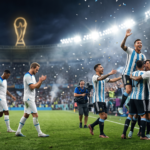








Can Argentina Defend Their World Title? A Definitive Tactical & Squad Deep Dive
TL;DR: The Quest for the Fourth Star
- The Core Philosophy: Lionel Scaloni has successfully transitioned Argentina from a team reliant solely on individual brilliance into a cohesive, unyielding collective pressing machine.
- The Maestro’s Role: Lionel Messi’s evolution continues. Wearing the iconic lionel messi argentina jersey now symbolizes absolute playmaking authority rather than just pure dribbling volume.
- Midfield Engine: The trio of Enzo Fernández, Alexis Mac Allister, and Rodrigo De Paul remains one of the most formidable and tactically fluid midfield blocks in modern international football.
- The Qualification Crucible: Cruising through the notoriously grueling argentina football world cup qualifying campaign, La Albiceleste has proven their grit across varied climates and hostile environments.
- Global Challengers: While considered one of the primary 2026 fifa world cup favorites, maintaining peak physical and psychological intensity against rejuvenated European heavyweights is their ultimate test.
Introduction: The Weight of the Crown
When Gonzalo Montiel’s penalty hit the back of the net in the Lusail Stadium on that fateful December night in 2022, it did more than just end a 36-year drought. It exorcised decades of national heartbreak, elevated Lionel Messi to indisputable mythological status, and placed the ultimate target on the back of La Albiceleste. As we look ahead, the prevailing question echoing through every premium football news portal and pundit’s desk is singular and monumental: Can Argentina defend their World Title?
Winning a FIFA World Cup is a Herculean task; defending it borders on the impossible. In the extensive history of the tournament, only Italy (1934, 1938) and Brazil (1958, 1962) have managed back-to-back conquests. The modern era of football, characterized by hyper-athleticism, instantaneous tactical analysis, and grueling domestic schedules, makes retaining the trophy an exponentially more complex endeavor. Yet, there is a palpable feeling within the Argentine camp—a mixture of serene confidence and insatiable hunger—that suggests this squad is not burdened by the crown, but rather empowered by it.
The aura surrounding the argentina football jersey has transformed. It is no longer a heavy garment woven with the threads of past failures; it is a shield of invincibility. To understand their chances in the upcoming tournament, we must embark on a deeply granular team analysis, dissecting everything from Lionel Scaloni’s evolving tactical blueprint to the emerging youth pipeline, and assessing how they measure up against the other formidable 2026 fifa world cup favorites.
The Scaloni Masterclass: A Tactical Evolution
The foundation of Argentina’s contemporary success is not merely the presence of generational talent, but the structural brilliance of their manager, Lionel Scaloni. Initially appointed as an interim caretaker, Scaloni—affectionately dubbed the architect of “La Scaloneta”—has orchestrated a profound tactical revolution. His approach is characterized by absolute pragmatism, emotional intelligence, and an unparalleled ability to adapt his system to the specific weaknesses of the opposition.
In our comprehensive match analysis sections spanning the last three years, a clear pattern emerges. Scaloni rarely anchors his team to a rigid formation. Whether deploying a traditional 4-3-3, a resilient 4-4-2, or a flexible 3-5-2 with aggressive wing-backs, the underlying principles remain constant: aggressive counter-pressing in the middle third, numerical superiority in midfield construction, and creating isolated 1-on-1 scenarios for their wide attackers. The current iteration of the team is less reliant on monopolizing possession and more focused on vertical, incisive transitions.
A critical component of this tactical evolution is the implementation of fluid asymmetry. Scaloni often overloads one flank—typically the left, drawing the opponent’s defensive block out of position—before executing rapid, sweeping diagonal switches to an advancing right-back or a drifting winger. This mechanism requires incredibly high footballing IQ and technical precision, traits that the current Argentine roster possesses in abundance. Furthermore, the psychological environment Scaloni has cultivated ensures that defensive duties are democratized. Every player, regardless of their superstar status, is expected to contribute to the defensive phase, making Argentina an incredibly suffocating team to play against.
Player Analysis: The Continuing Saga of Lionel Messi
Any discourse regarding Argentina unequivocally centers around the maestro himself. At this stage in his career, Lionel Messi is transcending traditional athletic timelines. Moving to Major League Soccer was initially viewed by some critics as a soft retirement, but the reality is far more strategic. By escaping the relentless, meat-grinding pressure of the European club calendar, Messi has effectively engaged in meticulous load management, preserving his physical and mental reserves specifically for international duty.
The sight of the lionel messi argentina jersey remains the most intimidating visual in world football. However, deep player performance insights reveal a fascinating evolution in his role. He is no longer the explosive right-winger who routinely bypasses three defenders with sheer acceleration. Today, Messi operates as a quintessential ‘enganche’—a traditional South American deep-lying playmaker operating in the half-spaces. He dictates the tempo, orchestrates the structural geometry of attacks, and delivers defense-splitting passes with unparalleled vision.
His statistical output remains staggering, but his true value lies in his gravitational pull. Opposing defenses naturally contract towards him, terrified of giving him a millimeter of space. This hyper-focus on Messi inadvertently creates massive pockets of space for his teammates. When analyzing his current metrics, his Expected Assists (xA) and progressive passing numbers are actually peaking. If Messi can maintain his current physical conditioning, his role as the cerebral orchestrator makes him arguably more dangerous than ever, relying on supreme intellect rather than raw pace.
Messi’s Changing Paradigm
- Positioning: Dropping deeper into the midfield to act as a central hub for possession.
- Efficiency: Focusing energy bursts specifically in the final third rather than sustaining high-intensity runs across the full pitch.
- Leadership: Transforming into a vocal, emotionally demonstrative captain who physically defends his teammates on the pitch.
- Set Pieces: Remaining one of the most lethal free-kick takers globally, providing a crucial avenue for breaking deadlocks.
The Engine Room: Midfield Supremacy
While Messi provides the magic, the true heartbeat of this Argentine squad lies in its midfield. The trio of Enzo Fernández, Alexis Mac Allister, and Rodrigo De Paul represents perhaps the most balanced and tactically intelligent midfield unit in international football today. Their synergy is the linchpin of Scaloni’s system, allowing Argentina to dominate the critical central zones.
Rodrigo De Paul operates as the ultimate box-to-box enforcer. His unparalleled stamina, aggressive tackling, and willingness to do the unglamorous defensive running provide the structural integrity that allows the creative players to flourish. He is essentially the bodyguard, relentlessly pressing opponents and ensuring that transitions are swiftly halted.
Enzo Fernández and Alexis Mac Allister provide the technical sophistication. Both players have thrived in the fast-paced environment of the English Premier League, bringing that intensity to the international stage. Mac Allister’s ability to operate in tight spaces, shield the ball, and execute rapid one-touch combinations makes him invaluable in breaking high presses. Enzo Fernández, meanwhile, acts as the deep-lying orchestrator, dictating the rhythm of the game with his expansive passing range. Together, this trio possesses an incredibly rare blend of elite technical ability, tactical discipline, and raw physical tenacity.
Defensive Blueprint & The Goalkeeping Phenomenon
Tournaments are notoriously won by defenses, and Argentina has constructed a formidable rear-guard. The central defensive partnership, often anchored by the aggressive and proactive Cristian Romero alongside the incredibly composed Lisandro Martínez or the veteran Nicolas Otamendi, provides a robust foundation. Romero’s tendency to step out of the defensive line to aggressively intercept passes prevents opponents from establishing a rhythm, while Martínez brings elite ball-playing abilities, crucial for initiating attacks from deep.
However, the psychological anchor of this defense is undeniably Emiliano ‘Dibu’ Martínez. His impact goes far beyond traditional goalkeeping metrics. Martínez is a master of the dark arts—psychological warfare that deeply unsettles opposing attackers, particularly during penalty shootouts. His sheer presence, massive wingspan, and unparalleled confidence infuse the entire squad with a sense of invulnerability. He is not just a shot-stopper; he is a crucial component of Argentina’s emotional armor.
The Qualification Crucible: Conquering CONMEBOL
To evaluate Argentina’s readiness, one must analyze their journey through the argentina football world cup qualifying campaign. The South American qualifiers are widely considered the most physically demanding and tactically rigorous qualification process on the planet. Teams must navigate extreme logistical challenges, ranging from the suffocating, lung-busting altitude of La Paz, Bolivia, to the sweltering, oppressive humidity of Barranquilla, Colombia.
Argentina’s performance in these qualifiers has been nothing short of a clinical procession. They have demonstrated an ability to grind out results in hostile environments, showcasing a pragmatic resilience that is essential for tournament football. They have proven they do not need to play beautiful football to secure three points; they can win ugly when the situation demands it. This adaptability—the capacity to switch from an expansive passing game to a rugged, defensive slog—is the hallmark of a champion side preparing to defend its title.
Global Demand: The Ticketing Phenomenon
The global obsession with this Argentine squad transcends borders, creating unprecedented logistical challenges and ticketing frenzies. When the national team plays, it is not merely a sporting event; it is a global spectacle. Fans are constantly scouring the internet for any opportunity to witness this era of players, searching frantically for terms like argentina vs algeria tickets, argentina vs austria tickets, and even obscure friendly match-ups like jordan vs argentina tickets.
This insatiable demand highlights the massive commercial and cultural footprint of the team. Everywhere they travel, they are treated like rock stars, playing in front of overwhelmingly partisan crowds regardless of the geographic location. This constant exposure to high-pressure, sold-out environments acts as a perpetual psychological conditioning, ensuring the players are completely desensitized to the intense atmosphere they will face during the actual World Cup.
| Historical World Cup Back-to-Back Winners | Tournament Years | Key Attributes of Defense | Argentina 2026 Similarity Index |
|---|---|---|---|
| Italy | 1934, 1938 | Tactical rigidity, physical dominance, masterful man-management by Vittorio Pozzo. | Moderate: Scaloni shares Pozzo’s pragmatic man-management, but with modern tactical fluidity. |
| Brazil | 1958, 1962 | Generational talent (Pelé, Garrincha), overwhelming offensive firepower, psychological superiority. | High: The reliance on a generational figurehead (Messi) combined with a deep roster of technical elites. |
| Argentina | 2022, 2026? | Cohesive pressing, midfield dominance, emotional unity, tactical adaptability. | N/A – Writing History |
Threat Assessment: The 2026 Contenders
While the focus is on Argentina, defending the title requires overcoming a formidable array of challengers. The list of 2026 fifa world cup favorites is heavily populated by European giants desperate to reclaim global dominance.
France remains the most potent threat. Blessed with a terrifying conveyor belt of elite talent, particularly in their blistering attacking flanks and physically imposing midfield, they are structurally designed to exploit the very spaces Argentina occasionally leaves vulnerable during transitions. England, possessing a golden generation of technically gifted attacking midfielders and a highly structured domestic system, represents another massive hurdle. Spain’s relentless possession-based control and Germany’s tactical rebirth under new management also pose significant threats.
Furthermore, Brazil, despite recent transitional struggles, remains an eternal powerhouse. A wounded Brazil, looking to avenge their recent tournament disappointments, is an incredibly dangerous proposition. Argentina’s path to retaining the trophy will undoubtedly require them to navigate a gauntlet of these elite nations, demanding absolute perfection in the knockout stages.
League Trend Analysis: The European Influence
Our deep-dive league trend analysis indicates that modern international football is increasingly mirroring the tactical nuances of elite European club competitions. The prevalence of inverted fullbacks, high-intensity zonal pressing, and the utilization of “false nines” are ubiquitous. Argentina’s squad is perfectly positioned to handle these trends, given that the vast majority of their starting XI are pivotal figures in top-tier European clubs.
Players like Alejandro Garnacho and Julián Álvarez are bringing the hyper-vertical, intense pressing styles learned under elite European managers directly into the national team setup. This seamless integration of modern club tactics with traditional South American technical flair creates a hybrid style that is incredibly difficult to counter. The ability of the Argentine players to rapidly switch tactical systems mid-game without suffering a drop in cohesion is a direct result of their rigorous daily club environments.
The Culture: What is Argentina Known For?
To truly understand this team, one must understand the nation. If you ask, what is argentina known for, beyond the iconic argentina football logo and the legendary figures of Maradona and Messi, the answer is an all-consuming, almost religious devotion to football. It is a nation where the sport is intrinsically woven into the social, economic, and cultural fabric. Football is not a pastime; it is the ultimate expression of national identity.
This profound cultural weight is what makes wearing the argentina soccer jersey such a heavy burden for some, but a source of limitless power for this current generation. The bond between the fans and the players—forged in the fires of the Copa America victory in the Maracanã and solidified in Qatar—is unbreakable. The players are not just competing for professional glory; they are fighting to bring fleeting moments of pure, unadulterated joy to a nation that views them as heroes.
Trending Football Topics: The Future is Now
As we approach the tournament, several trending football topics will influence the landscape. The introduction of the new fifa world cup ball 2026, expected to feature even more advanced aerodynamic properties and integrated tracking technology, will be heavily scrutinized by goalkeepers and set-piece takers alike. Additionally, the expanded 48-team format alters the tournament dynamics significantly. The physical toll of potentially playing an extra knockout match places a massive premium on squad depth, load management, and sports science—areas where the Argentine federation has invested heavily in recent years.
The integration of youth is another crucial storyline. While the veterans provide the foundation, the injection of fearless, dynamic young talent is what prevents a squad from going stale. Scaloni has been meticulous in slowly integrating the next generation, ensuring that the tactical principles of La Scaloneta will outlive its founding members.
The Final Verdict
Can Argentina defend their World Title? The empirical evidence, match statistics sections, and tactical blueprints suggest they are more than capable. They possess a manager of supreme intellect, a midfield that dictates the terms of engagement against any opponent, a defense fortified by psychological resilience, and a captain who operates on a plane of footballing reality that mere mortals cannot access.
Defending a World Cup requires a perfect storm of tactical execution, supreme physical conditioning, and a bit of serendipitous luck. However, this Argentine squad has proven time and again that they do not rely on luck; they manufacture their own destiny through collective willpower. As they prepare to step onto the grandest stage once more, draped in the blue and white stripes, they do so not as hopeful contenders, but as absolute conquerors ready to fiercely protect their throne.
Frequently Asked Questions (FAQs)